

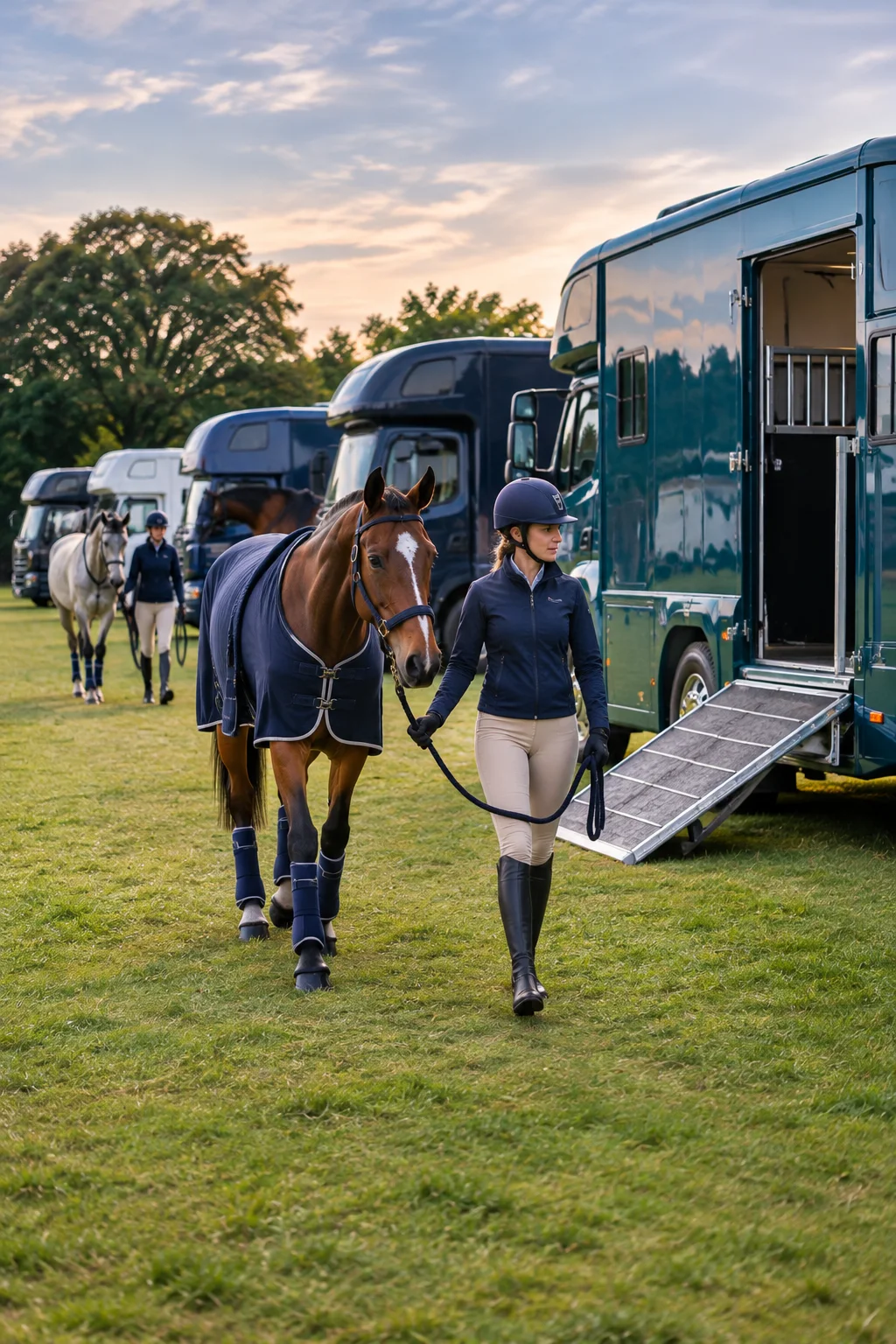

Travelling to a horse show well starts the night before, not when you pull out of the yard. Most stressful show days are caused by the same things: a late start, a forgotten passport, a horsebox that will not start, a horse that will not load, or a car park that turns into a swamp. A simple plan removes almost all of them.
This guide covers working back from your class time, preparing the vehicle and horse, a practical packing list, arriving and parking, and getting home safely.
Key points
- Work backwards from your class time and add generous buffers.
- Check the vehicle and pack the evening before.
- Passports must travel with the horses.
- Plan the journey home: tired horses and tired drivers need care too.
Plan your timings backwards
Start with the time you need to be in the warm-up arena and count back. A typical plan for a local show might look like this:
| Task | Time to allow |
|---|---|
| Warm-up before your class | 20 to 40 minutes |
| Tacking up and getting changed | 20 to 30 minutes |
| Unloading, settling and checking the horse | 15 to 30 minutes |
| Collecting numbers, walking the course | 20 to 45 minutes |
| Parking and queueing at the entrance | 15 to 30 minutes |
| The journey itself | Route time plus at least 25% for horses and traffic |
| Loading at home | 15 to 30 minutes, more for difficult loaders |
| Final vehicle checks | 10 to 15 minutes |
Horse transport is slower than normal driving. You will be driving gently, avoiding hard braking and taking roundabouts slowly, so do not use your satnav’s car estimate without adding time. If you are driving from Chelmsford along the A12 or A130, or crossing the M25 corridor, allow for roadworks and peak-time queues.
The night before
- Vehicle checks: tyres, lights, fluids, floor and partitions. Use our horsebox safety checklist.
- Fuel: fill up so you do not need to stop with horses on board.
- Load the kit: pack everything except perishables.
- Prepare the horse: bath or groom, plait if needed, check shoes.
- Check the schedule: class times, venue directions, lorry park entrance and any parking instructions.
- Weather: check the forecast and plan rugs and water accordingly.
Show day packing list
Documents
- Horse passports, which must travel with each horse. See our horse passport guide.
- Entry confirmations, membership cards and any vaccination records required by the show.
- Driving licence and breakdown cover details.
For the horse
- Saddle, bridle, girth, numnah and boots.
- Travel boots or bandages, tail guard and poll guard. Our guide to horse travel boots and rugs explains the options.
- Rugs for before and after: cooler, waterproof and a light sheet.
- Haynets, feed, water from home and buckets.
- Grooming kit, fly spray, hoof oil, studs and stud kit.
- Spare headcollar, lead rope and leather headcollar for travel.
- Equine first aid kit and thermometer.
For you
- Hat, body protector, gloves, boots, show jacket and spares.
- Food, drinks and a flask.
- Waterproofs, warm layers, sun cream.
- Phone charger, cash and card.
For the vehicle
- Hi-vis vests and warning triangle.
- Tow rope or recovery strap if the show field is soft.
- Spare shavings, skip and fork, and bin bags.
On the road
- Drive smoothly and leave large gaps.
- Keep vents open for air.
- On longer journeys, stop to check horses and offer water. Our guide to keeping horses hydrated explains when.
- If you are delayed, ring the show office rather than rushing.
Arriving and parking
- Follow stewards and lorry park signs; do not stop on approach roads.
- Park on level ground with space to lower ramps safely, away from busy walkways.
- In wet conditions, avoid soft hollows and leave space to pull out forwards.
- Unload calmly, let the horse look around, and offer water.
- Tie up horses outside the vehicle only to secure points with breakable twine, and never leave them unattended.
The journey home
Show days are tiring for horses and riders. Let your horse cool down fully, walk off, drink and eat before loading. Do not rush to beat the queue out of the car park. Check legs and remove studs before travelling. If you feel tired, take a break before driving; fatigue is a real risk on the way home.
Frequently asked questions
How early should I arrive at a horse show?
For most riders, 60 to 90 minutes before the class is a comfortable minimum. Big shows, complicated parking or several classes may need more.
Should my horse wear travel boots to a show?
Most horses travel in some leg protection. On very hot days for short trips, some owners choose less. Choose kit you can fit properly.
What if my horse will not load at the show?
Stay calm, ask for help from experienced people, and allow time. Practising loading at home is the best prevention; see our guide to how to load a horse.
Summary
Work backwards from your class, prepare the night before, pack from a list, drive gently and give your horse time to recover before going home. A calm show day almost always starts with a calm journey. The British Horse Society has more advice on transporting your horse.