

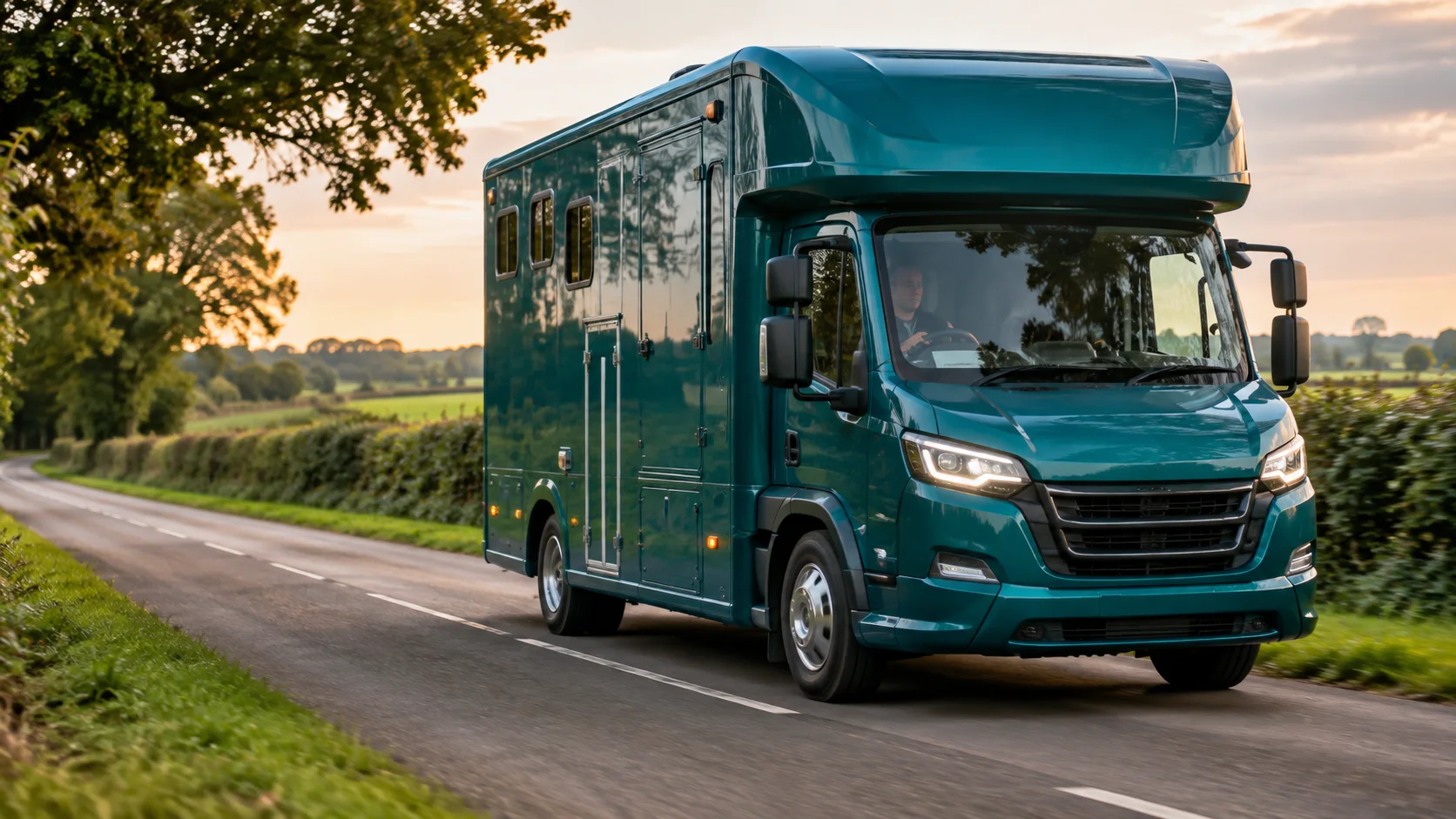

Working out which licence to drive a horsebox you need is the first job before you buy, borrow or hire one. The answer depends on two things: how heavy the horsebox is allowed to be when fully loaded, and when you passed your car test. Get either wrong and you could be driving without a valid licence, which also tends to mean driving without valid insurance.
This guide explains the licence categories in plain English, shows you how to check what your own licence covers, and walks through the route to a C1 entitlement if you need one. It is written for private owners in Chelmsford and across Essex, but the rules are the same throughout Great Britain.
Key points
- A horsebox up to 3,500kg maximum authorised mass (MAM) can be driven on a standard car (category B) licence.
- Between 3,500kg and 7,500kg you need category C1. Over 7,500kg you need category C.
- If you passed your car test before 1 January 1997 you will usually already hold C1, but you can lose it at 70 unless you renew with a medical.
- The weight that counts is the plated maximum, not what the box weighs on the day.
Why the weight on the plate decides everything
Licence categories are based on maximum authorised mass, often shortened to MAM or called gross vehicle weight. This is the most the vehicle is allowed to weigh on the road with fuel, people, horses, tack and water on board. It is set by the manufacturer and, for vehicles over 3.5 tonnes, recorded on a ministry plate fitted in the cab.
That matters because a horsebox that weighs 2.6 tonnes empty but is plated at 4.5 tonnes is a 4.5 tonne vehicle for licensing purposes. Even if you only ever carry one small pony, you still need the licence for the plated weight. The reverse is also true: a box plated at 3.5 tonnes can be driven on a car licence, but only if you keep it under 3.5 tonnes when loaded. We cover that balancing act in detail in our guide to horsebox weight and payload.
Where to find the plated weight
- On the V5C logbook: look for the “maximum permissible mass” entry.
- On the ministry plate: vehicles over 3,500kg have a plate in the cab, usually on the door frame or under the dashboard, showing gross and axle weights.
- On the manufacturer’s VIN plate: useful for 3.5 tonne conversions built on van chassis.
The licence categories that apply to horseboxes
Here is how the main categories line up with the horseboxes you are likely to see on the road.
| Horsebox plated weight | Licence category | Minimum age | Typical vehicle |
|---|---|---|---|
| Up to 3,500kg | B (car) | 17 | Van-based 3.5 tonne box for one or two horses |
| 3,501kg to 7,500kg | C1 | 18 | 4.5t, 6.5t and 7.5t lorries, often with living |
| Over 7,500kg | C | 21 | Larger competition lorries |
The C1 category also has a towing version, C1E, which allows a C1 vehicle to pull a heavier trailer. Most private horse owners will never need it, but it can appear on older licences automatically.
If you passed your test before 1 January 1997
Drivers who passed a car test before 1 January 1997 were given extra entitlements when the licence rules changed, often called “grandfather rights”. In practice this usually means your licence shows categories C1 and C1E, so you can drive a horsebox up to 7,500kg without taking another test.
There are two important catches:
- Turning 70. When you renew your licence at 70, the C1 entitlement is not renewed automatically. To keep driving a box over 3.5 tonnes you need to complete a D4 medical and apply to keep the category. Plenty of owners only discover this when they are stopped or when their insurer asks.
- Driving for a living. Grandfather rights cover private use. If driving the lorry becomes part of your job, Driver CPC rules may apply on top of the licence category.
If you passed your test on or after 1 January 1997
A standard car licence issued after that date covers vehicles up to 3,500kg MAM. That puts most 3.5 tonne horseboxes within reach, but anything heavier needs a C1 (or C) entitlement. There is no shortcut and no “small lorry” exemption for horseboxes.
The Department for Transport has consulted on whether to reintroduce something like the old grandfather rights for car drivers. At the time of writing it remains a consultation, not a change in the law, so do not plan a lorry purchase around it.
How to check what your licence covers
- Go to the official View or share your driving licence information service on GOV.UK.
- Enter your licence number, National Insurance number and postcode.
- Look at the categories listed as “full” entitlements. Provisional categories do not allow you to drive unaccompanied.
- Check any expiry dates against categories such as C1. These can expire earlier than the car entitlement.
The back of your photocard also lists categories, but the online record is the one to trust if the two differ, for example after an automatic update such as the 2021 towing change.
Getting a C1 licence: the route step by step
If you want a 4.5 or 7.5 tonne box and passed your car test from 1997 onwards, this is the usual path:
- Medical: complete a D4 medical with a doctor or approved provider.
- Provisional entitlement: apply to add provisional C1 to your licence using form D2, sent with the D4.
- Theory tests: pass the multiple-choice and hazard perception tests for large vehicles.
- Practical training: most people book a short intensive course with a lorry training school. Prices vary widely, so compare what is included, such as test fees and vehicle hire on the day.
- Practical tests: an off-road manoeuvring test and an on-road driving test.
If you only intend to drive your own horses to shows and lessons, you do not need the extra Driver CPC modules that professional drivers take. Check GOV.UK for the current requirements before you book anything.
Towing instead of driving a horsebox
Many owners sidestep the lorry licence question entirely by using a car and trailer. Since 16 December 2021, anyone with a full car licence can tow a trailer up to 3,500kg MAM without passing a separate trailer test, provided the tow vehicle is rated to pull it. We explain the details, and the limits that still apply, in our guide to towing a horse trailer on a car licence.
If you are still weighing up the two options, our comparison of horse trailer vs horsebox looks at running costs, safety and practicality side by side.
Licences, insurance and borrowed horseboxes
Insurers ask about licence categories for good reason. If you drive a 4.5 tonne box on a car-only licence, your policy is very likely to be invalid, which leaves you personally liable for any damage or injury. The same applies when you borrow a friend’s lorry: being named on their insurance does not give you a licence entitlement you do not hold.
Before driving someone else’s horsebox, check three things: the plated weight, your licence categories, and that the insurance covers you as a driver for that use. It takes five minutes and avoids a very expensive surprise.
Private use, commercial use and other paperwork
A licence category is only part of the picture once money changes hands. If you are paid to move other people’s horses, or use a horsebox for a business, you may also need an operator licence, a tachograph and an animal transport certificate of competence. These rules are covered in our guides to the horsebox operator licence and tachographs and transporter authorisations.
Frequently asked questions
Can I drive a 3.5 tonne horsebox on a car licence?
Yes. A category B licence covers vehicles up to 3,500kg MAM, so a 3.5 tonne horsebox is allowed. You must keep the loaded weight within 3,500kg, which is harder than it sounds with two horses on board.
Can I drive a 7.5 tonne horsebox on a car licence?
Only if you passed your car test before 1 January 1997 and your licence still shows a valid C1 entitlement. Otherwise you need to pass the C1 tests.
Does a downplated horsebox count as 3.5 tonnes?
If a heavier lorry has been officially downplated to 3,500kg and the paperwork has been updated, it is treated as a 3.5 tonne vehicle. It then has to stay within that lower limit when loaded, which often leaves very little payload.
Do I need a special licence to carry horses?
Not for your own horses on private journeys. Commercial transport over 65km brings in extra requirements, including a certificate of competence, but these sit alongside your driving licence rather than replacing it.
The bottom line
Check the plated weight first, then check your licence record online. If the two do not match, sort out the licence before you sort out the horsebox. This article is general guidance for horse owners, not legal advice, and the official rules on GOV.UK driving licence categories always take precedence.