

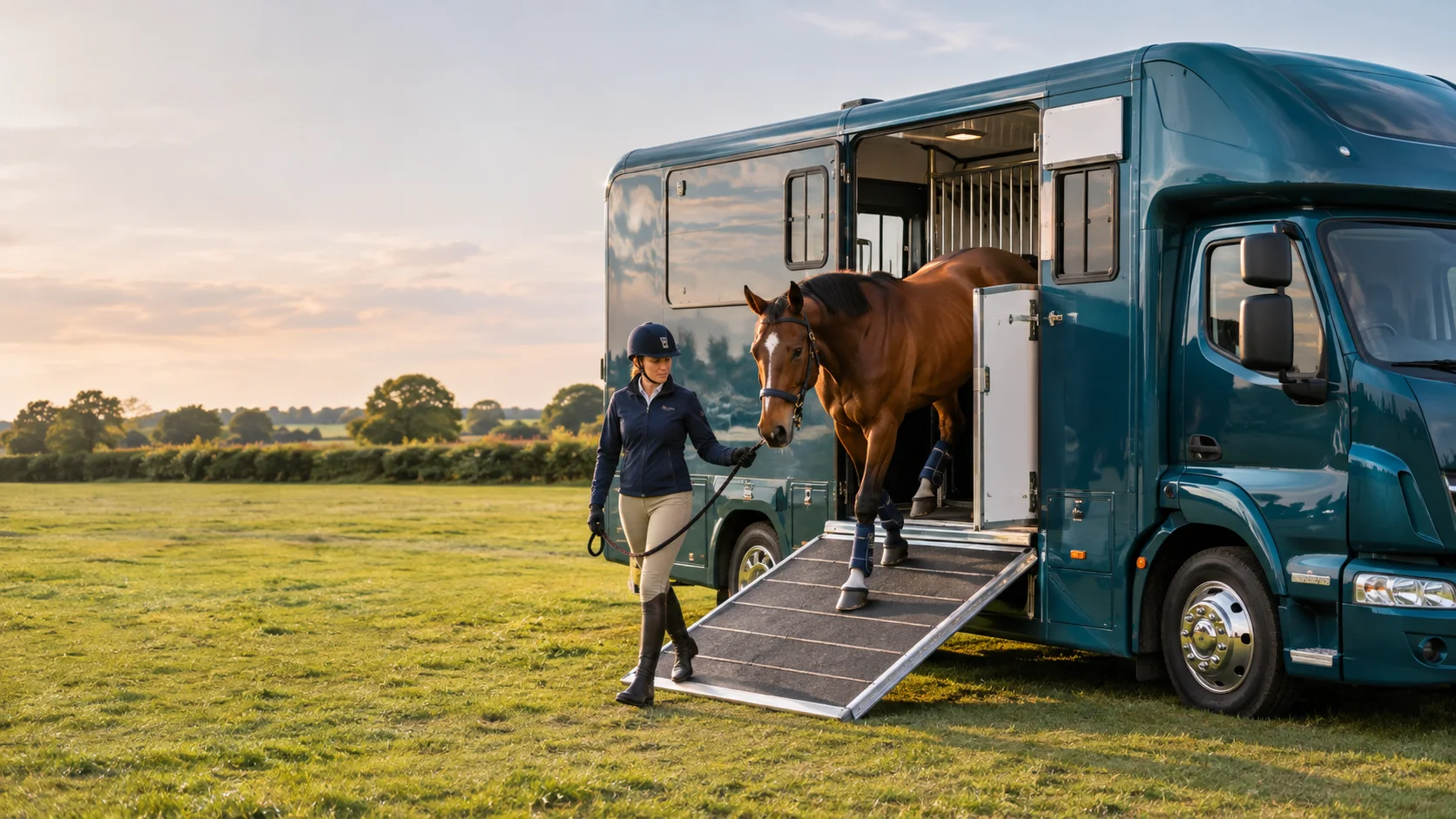

Your horsebox payload is the difference between what the vehicle weighs empty and the most it is allowed to weigh on the road. It sounds like simple arithmetic, yet overloading is one of the most common problems roadside examiners find on horseboxes, particularly on 3.5 tonne conversions carrying two horses. Most owners who are caught out had no idea they were over the limit.
This guide shows you how to find your real payload, how to add up everything you carry, why axle weights matter on bigger lorries, and what you can do if the numbers simply do not work.
Key points
- Payload = maximum authorised mass (MAM) minus the real unladen weight from a weighbridge.
- Payload must cover horses, people, fuel, water, tack, hay and everything in the lockers.
- A box stalled for two horses is not automatically legal to carry two horses.
- On 7.5 tonne lorries, individual axle limits can be exceeded even when the total is legal.
The three weights you need to know
| Term | What it means | Where to find it |
|---|---|---|
| MAM / gross vehicle weight | The most the loaded vehicle may weigh | V5C, VIN plate, ministry plate |
| Unladen weight | What the vehicle weighs empty with a driver and fuel (definitions vary) | A weighbridge ticket, not the advert |
| Payload | MAM minus unladen weight | Your own calculation |
Sellers often quote a payload in adverts, but conversions add weight in ways the original van or chassis figures do not show: partitions, ramps, living areas, water tanks, leisure batteries and extra flooring all count. The only figure worth trusting is one you have measured.
How to weigh your horsebox
- Find a public weighbridge. Many commercial sites, farm merchants and recycling centres around Essex offer public weighing for a small fee. Phone first, as some only weigh at certain times.
- Weigh it as you normally travel, minus the horses. Full fuel tank, your usual kit in the lockers, water tank as you normally fill it, and the driver on board.
- Ask for a printed ticket. The British Horse Society recommends keeping a weighbridge certificate so you know your unladen weight for certain.
- Weigh each axle if you can. Some weighbridges can do this. It is invaluable for 7.5 tonne lorries.
- Repeat with horses on board before a long season, so you know exactly where you stand.
Adding up a typical load
Here is an illustration for a 3.5 tonne horsebox whose weighbridge ticket shows 2,550kg with a full tank and the driver on board.
| Item | Approximate weight |
|---|---|
| Payload available (3,500 − 2,550) | 950kg |
| One 16hh horse | 550 to 600kg |
| Passenger | 70 to 90kg |
| Saddle, bridle, rugs, boots, grooming kit | 30 to 50kg |
| Hay net and feed for the day | 10 to 15kg |
| Water (1 litre weighs 1kg) | 25 to 50kg |
| Mucking out tools, first aid kit, spares | 15 to 25kg |
One horse and a passenger can fit comfortably. Add a second horse of 550kg and the box is roughly 300 to 400kg over its limit. That is why the British Horse Society and horsebox organisations warn that very few genuine two-horse loads are legal in a 3.5 tonne vehicle unless the horses are small and the box is unusually light.
Weighing your horse
A weigh tape gives a reasonable estimate, but a weighbridge at your vet’s practice or a livestock scale is more accurate. Native ponies and cobs are often heavier than their height suggests, while fine thoroughbreds can be lighter. Use the real figure, not a guess.
Why axle weights matter on bigger lorries
Every axle has its own maximum load, shown on the ministry plate. On a 7.5 tonne lorry with living accommodation at the front and horses at the back, the balance changes with every horse you load or unload. A lorry can be legal overall yet overloaded on the front axle, for example when you drive home with one horse after leaving another at a yard. The extra weight of a full water tank behind the cab, or a heavy generator in a front locker, has the same effect.
If you own a 7.5 tonne box, an axle-by-axle weigh with your common combinations of horses is worth doing once, so you know which arrangements to avoid.
What happens if you are overweight
DVSA examiners weigh vehicles at the roadside and use weigh-in-motion sensors on major routes to select vehicles for checks. If your horsebox is over its plated weight you can face a fixed penalty or prosecution, and an overloaded vehicle may be prohibited from moving until the excess is removed. With horses on board, that can mean waiting at the roadside for another vehicle.
The bigger risk is safety. Brakes, tyres, suspension and steering are all designed around the plated weight. An overloaded box takes longer to stop and handles less predictably in an emergency, exactly when your horses need you to be in control. Insurers may also question a claim if the vehicle was overloaded at the time.
Ways to free up payload
- Carry less water. Many venues have water. Fill the tank for long journeys only.
- Empty the lockers. Spare rugs, heavy tools and duplicate tack add up quickly.
- Move people, not horses. A passenger can follow in a car with the heavier kit.
- Fill up near the venue. A full tank of diesel can weigh 60 to 80kg.
- Remove unused fittings. Old partitions, heavy rubber matting layers and redundant furniture all weigh something.
Uprating and downplating
Some vehicles can be officially uprated to a higher MAM if the chassis, axles, brakes and tyres allow it. A 3.5 tonne box uprated to 4.5 tonnes gains a useful payload, but you then need a C1 licence, the goods vehicle annual test and possibly tachograph rules. Our guide to the licence to drive a horsebox explains the licence side, and our article on operator licences and tachographs covers the rest.
Downplating a heavier lorry to 3.5 tonnes so it can be driven on a car licence usually leaves too little payload to be practical. Be very cautious about buying a downplated box for horse use without weighing it first. See our used horsebox buying guide for other checks before you buy.
Trailers have weight limits too
A horse trailer has its own maximum authorised mass shown on its plate, and the loaded trailer must also stay within the tow car’s limits. The same arithmetic applies: trailer weight plus horses plus kit must stay below both. Our guide to towing a horse trailer includes a worked example.
Frequently asked questions
Can a 3.5 tonne horsebox legally carry two horses?
Sometimes, but rarely with two full-size horses. You need a light box, light horses and very little kit. Weigh it before you assume it is legal.
Does the payload include the driver?
That depends on how the unladen weight was measured. If the weighbridge ticket was taken with the driver on board, the driver is already counted. If not, the driver comes out of the payload.
How often should I weigh my horsebox?
Weigh it when you buy it, after any conversion work, and whenever your usual load changes, such as a new horse or a second rider joining you.
Summary
Know your true unladen weight, add up every horse and every kilo you carry, and keep a margin rather than running at the limit. A horsebox payload that works on paper and on the weighbridge is the foundation of every safe journey. For official guidance, see the GOV.UK page on transporting horses in horseboxes and trailers.