

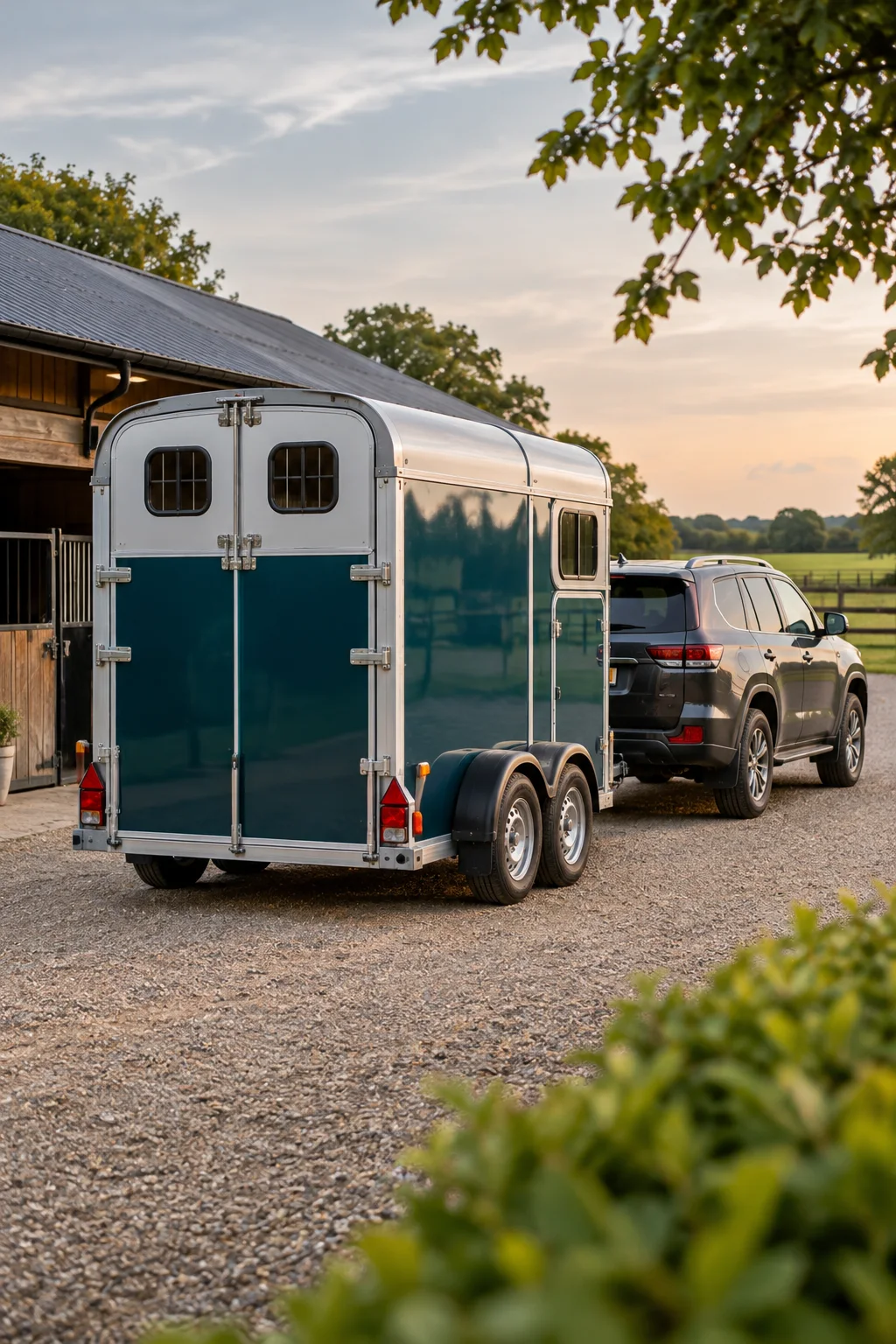

Towing a horse trailer became a lot simpler for younger drivers on 16 December 2021, when the separate car and trailer (B+E) test was scrapped in Great Britain. Many owners took that to mean “anything goes”. It does not. The licence rule changed, but the limits set by your car, your trailer and the law on speed and loading all still apply.
This guide explains exactly what changed, what you can now tow on a car licence, how to match a tow car to a loaded horse trailer, and the safety habits that matter far more than the paperwork.
Key points
- Since 16 December 2021, a full car licence lets you tow a trailer up to 3,500kg MAM, whenever you passed your test.
- Your car’s towing limit, nose weight limit and train weight still cap what you can legally pull.
- Speed limits when towing are 50mph on single carriageways and 60mph on dual carriageways and motorways.
- Training is no longer compulsory, but it is still the best money most new towers ever spend.
What changed in December 2021
Before the change, anyone who passed their car test on or after 1 January 1997 could only tow a heavy trailer if they passed an extra practical test. A typical two-horse trailer loaded with horses weighs well over 750kg, so in practice most post-1997 drivers needed B+E to tow horses at all.
The Driver and Vehicle Standards Agency stopped car and trailer tests in September 2021, and the law changed on 16 December 2021. From that date, drivers with a full category B licence can tow trailers up to 3,500kg maximum authorised mass (MAM). DVLA updated driving records automatically, and the BE category is added to the photocard the next time a new one is issued.
What did not change
- Drivers who passed before 1997 keep their existing entitlements, usually allowing a combined weight up to 8,250kg MAM.
- Horseboxes over 3,500kg still need a C1 or C licence. Towing rules do not affect lorry licences. See our guide to the licence to drive a horsebox.
- The rules on vehicle weights, speed limits, lights and trailer condition are exactly the same.
Matching the tow car to the trailer
The licence lets you tow up to 3,500kg, but very few cars can. The real limit is usually the car. Every vehicle has a maximum towing weight set by the manufacturer, shown in the handbook and often on the VIN plate. You must not exceed it.
The numbers to check
| Figure | Where to find it | Why it matters |
|---|---|---|
| Braked towing limit | Car handbook, VIN plate | The heaviest braked trailer the car may pull |
| Gross train weight | VIN plate | Maximum combined weight of loaded car plus loaded trailer |
| Maximum nose weight | Handbook, towbar label | Downward load on the tow ball |
| Trailer MAM | Trailer plate | Maximum loaded weight of the trailer |
A worked example
Imagine a two-horse trailer that weighs 1,300kg empty, carrying two horses of 550kg each plus 60kg of tack, water and hay. The loaded trailer weighs about 2,460kg. Your car needs a braked towing limit of at least that figure, and the car plus trailer together must stay under the gross train weight. Many family SUVs are rated at 2,000 to 2,500kg, which leaves very little margin. A larger 4×4 or pick-up rated at 3,000kg or more gives you headroom for hills, wind and emergency braking.
A common rule of thumb in the caravan world is to keep the loaded trailer at or below 85% of the car’s kerb weight for stability. It is not a legal limit, but it is a sensible one when your load can move.
Speed limits and lane rules when towing
When you tow a horse trailer with a car, lower national limits apply.
- Built-up areas: 30mph (20mph in much of Wales), the same as without a trailer.
- Single carriageways: 50mph.
- Dual carriageways: 60mph.
- Motorways: 60mph, and you must not use the outside lane of a motorway with three or more lanes.
These are maximums, not targets. Horses balance themselves continuously while you drive, so smooth acceleration, gentle braking and slow cornering matter more than arrival time. Many experienced owners rarely exceed 50mph with horses on board.
Before every journey: the towing checks
A trailer that sits in a field between outings needs checking every time. Our full pre-travel safety checklist covers horseboxes and trailers in detail, but the towing essentials are these:
- Coupling: the hitch head is fully seated on the ball and the indicator shows it is locked.
- Breakaway cable: attached to a dedicated point on the car, not looped over the ball.
- Electrics: lights, indicators, brake lights and number plate light all work. Check with a helper.
- Tyres: pressures set to the trailer maker’s figures, no cracking or bulges, and tyres not too old. Trailer tyres often age out before they wear out.
- Jockey wheel: fully raised and clamped.
- Floor and ramp: no soft spots, rot or damaged springs. See how to check a horsebox floor.
- Number plate: the trailer plate matches the car.
Driving technique with horses behind you
Towing horses is different from towing a caravan because the load is alive and moves. A horse shifting its weight on a roundabout can be felt in the steering. These habits make the biggest difference:
- Leave a much larger gap to the vehicle ahead so you can brake progressively.
- Brake in a straight line before bends, then drive through at a steady speed.
- Take roundabouts slowly and allow for the trailer cutting in.
- Change gear smoothly; a jerky clutch is felt in the trailer.
- Watch for crosswinds on open roads such as the A12 and A130, and when lorries pass.
- If the trailer starts to snake, ease off the accelerator and keep the wheel straight. Do not brake hard or steer sharply.
Is training still worth it?
Yes. The B+E test disappeared, but the skills it tested did not. DVSA itself encourages new towers to take training, and many trailer manufacturers and driving schools offer short practical courses on hitching, reversing and manoeuvring. A morning spent reversing into a tight space at a training ground is much less stressful than learning in a busy show lorry park with a horse on board.
Practise with an empty trailer first: reversing in a straight line, reversing round a corner, turning in a confined space and parking. Then practise with a calm, experienced horse on short, quiet journeys before you attempt a long trip.
Insurance and breakdown cover
Tell your car insurer that you tow, and check that your policy covers the trailer for third-party liability. Separate trailer insurance covers theft and damage to the trailer itself. Breakdown cover is just as important: many standard policies will not recover a loaded horse trailer, so look for specialist equine recovery cover. Our guide to horse transport insurance explains what to look for.
Frequently asked questions
Can I tow a horse trailer if I passed my test after 1997?
Yes. Since 16 December 2021 you can tow a trailer up to 3,500kg MAM on a full car licence, as long as your car is rated to tow the loaded weight.
Do I need to update my licence?
No action is needed. DVLA updated driving records automatically, and BE will appear on your next photocard.
Can I tow a horse trailer behind a horsebox?
That needs a C1E or CE entitlement, depending on the lorry’s weight, and the combination has to stay within the lorry’s train weight. It is rarely practical for private owners.
Does a horse trailer need an MOT?
Light trailers up to 3,500kg do not need an MOT in Great Britain, but they must be roadworthy. The National Trailer and Towing Association offers free safety checks for trailers of that size.
Summary
The 2021 change removed a test, not the responsibility. Check your car’s towing figures against the loaded trailer, respect the towing speed limits, carry out your checks before every journey and get some practical training. For the official wording, see the GOV.UK pages on towing with a car and speed limits.