

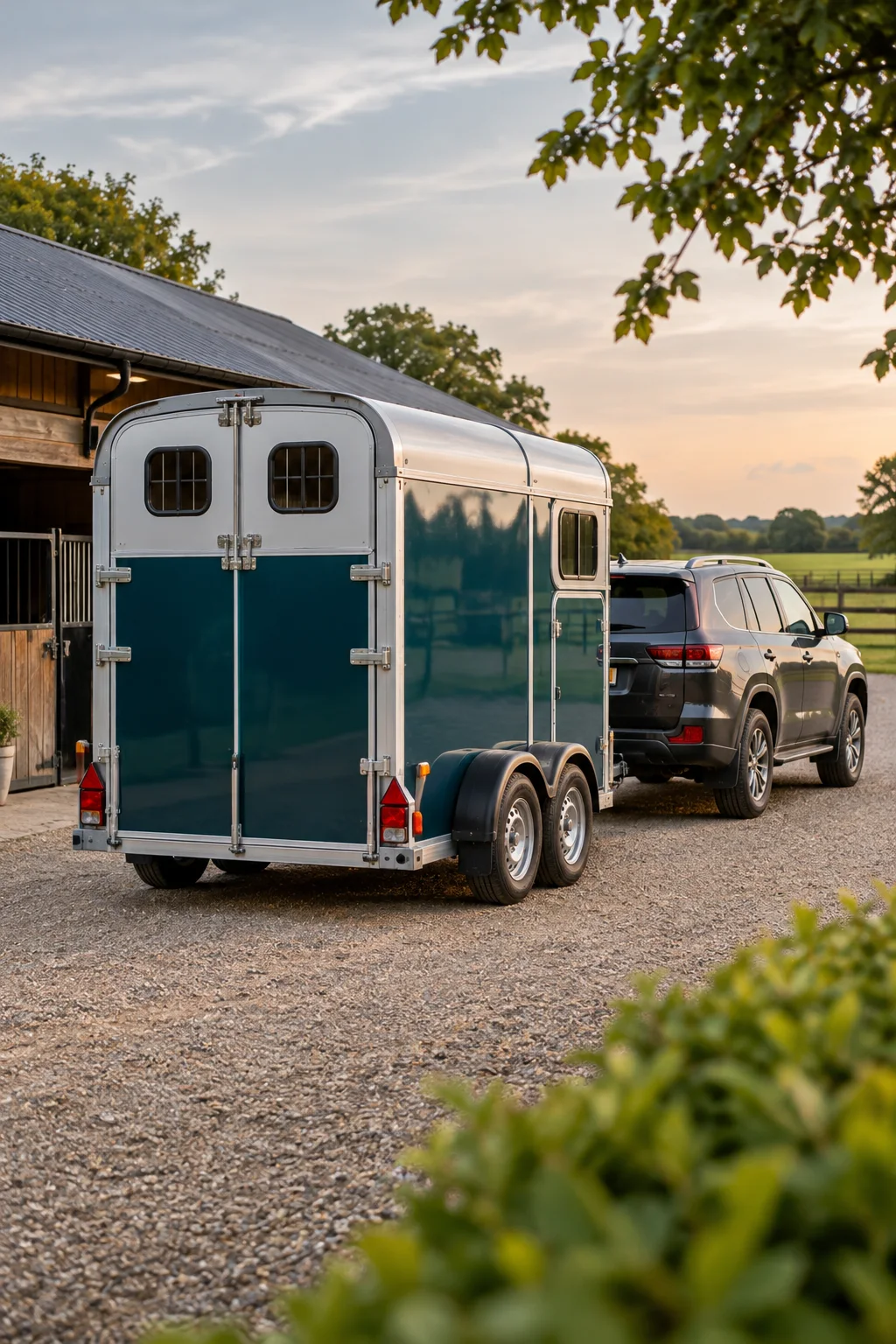

The horse trailer vs horsebox question comes up for almost every owner sooner or later. Both will get a horse from A to B. They differ in cost, licensing, comfort, convenience and how they cope with the realities of Essex roads, show car parks and winter fields. There is no single right answer, but there is usually a right answer for you.
This guide compares the two honestly, with a side-by-side table, the questions to ask yourself and the situations where each one makes most sense.
Key points
- Trailers are usually cheaper to buy and maintain, but need a capable tow car.
- Horseboxes are easier to manoeuvre with horses on board and often more comfortable for horses and people.
- Licensing, payload and running costs often decide the matter.
- Your horse’s temperament and the journeys you make matter as much as price.
Side-by-side comparison
| Factor | Car and trailer | Horsebox |
|---|---|---|
| Purchase cost | Lower for the trailer, but you may need a bigger tow car | Higher, especially with living |
| Licence | Full car licence can tow up to 3,500kg MAM | Car licence up to 3,500kg; C1 above that |
| Annual testing | No MOT for light trailers; tow car MOT as usual | MOT up to 3,500kg; goods vehicle test above |
| Insurance | Trailer cover plus tow car policy | Specialist horsebox policy |
| Driving | Reversing and snaking take practice | Feels like a van or lorry; easier to reverse |
| Horse comfort | More movement, especially at the back | Usually smoother ride, more space |
| Loading | Narrow space; front unload helps | Side ramps, herringbone stalls, often easier |
| Facilities | Limited tack storage | Tack lockers, often a kitchen or seating |
| Everyday use | Tow car is your normal car when unhitched | A second vehicle to tax, insure and maintain |
| Storage | Easier to park at a yard | Needs more space and access |
When a trailer makes sense
- You already own, or need, a capable 4×4 or pick-up.
- You travel one or two horses on shorter journeys.
- Your budget is limited and you want lower fixed costs.
- You passed your test after 1997 and do not want to take a C1 test.
- Your yard has limited parking.
Since December 2021, any full car licence holder can tow up to 3,500kg MAM. The tow car’s own limits are what matter; our guide to towing a horse trailer explains how to check them.
When a horsebox makes sense
- You travel often, to shows, clinics or hunting.
- You carry two large horses, which is often only legal in a heavier box.
- You want somewhere to change, make tea and shelter at events.
- Your horse travels better with more space.
- You find reversing a trailer stressful.
Remember that a 3.5 tonne box can be legally driven on a car licence but has a limited payload. Our guide to horsebox weight and payload explains why. Heavier boxes need C1, covered in our horsebox licence guide.
Horse comfort and safety
A trailer sits behind the tow car, so it moves more in crosswinds and on bumpy roads, and horses at the back of the trailer feel braking and cornering more. Horseboxes are part of a single rigid vehicle, often with better suspension and more headroom. Many horses that are anxious in a trailer travel calmly in a lorry, and vice versa. If your horse has a strong preference, take it seriously; a horse that scrambles in one type of vehicle is at risk of injury.
Running costs to compare
- Fuel: a tow car pulling a loaded trailer uses much more fuel than usual; a horsebox engine works hard too. Compare real consumption, not brochure figures.
- Insurance and breakdown: include equine recovery cover for both.
- Servicing: trailer brakes, bearings and floors; horsebox engine, chassis, floor and coachwork.
- Tax and testing: horseboxes need their own tax and test; light trailers do not.
- Depreciation: good trailers hold value well; horseboxes vary widely.
Practical considerations around Chelmsford and Essex
Many Essex yards sit down narrow country lanes, with tight gateways and soft ground in winter. A trailer behind a 4×4 can cope well with muddy fields, while a heavy lorry can get stuck. On the other hand, a horsebox is easier on busy routes such as the A12 and A130, and in crowded show lorry parks. Think about your own yard access, the venues you use and the roads you drive most.
Questions to ask yourself
- How many horses do I carry, and how heavy are they?
- What does my licence allow?
- Do I already own a suitable tow vehicle?
- How far and how often will I travel?
- How does my horse travel now?
- Where will the vehicle be kept?
- What can I afford to run, not just to buy?
Frequently asked questions
Is a horsebox safer than a trailer?
Both are safe when well maintained, correctly loaded and driven carefully. Horseboxes are more stable in many conditions, but a well-matched car and trailer driven sensibly is perfectly safe.
Can I hire either option?
Yes. Hiring a horsebox or trailer before you buy is a good way to see which suits you and your horse. Check insurance and licence requirements first.
What if I only travel a few times a year?
Using a professional transporter may be cheaper than owning either. See our guide to choosing a horse transporter.
Summary
Trailers win on purchase cost and flexibility; horseboxes win on comfort, convenience and capacity. Start with your licence, your horses and your journeys, and the right choice usually becomes clear. For current rules, see the GOV.UK guidance on horseboxes and trailers.