

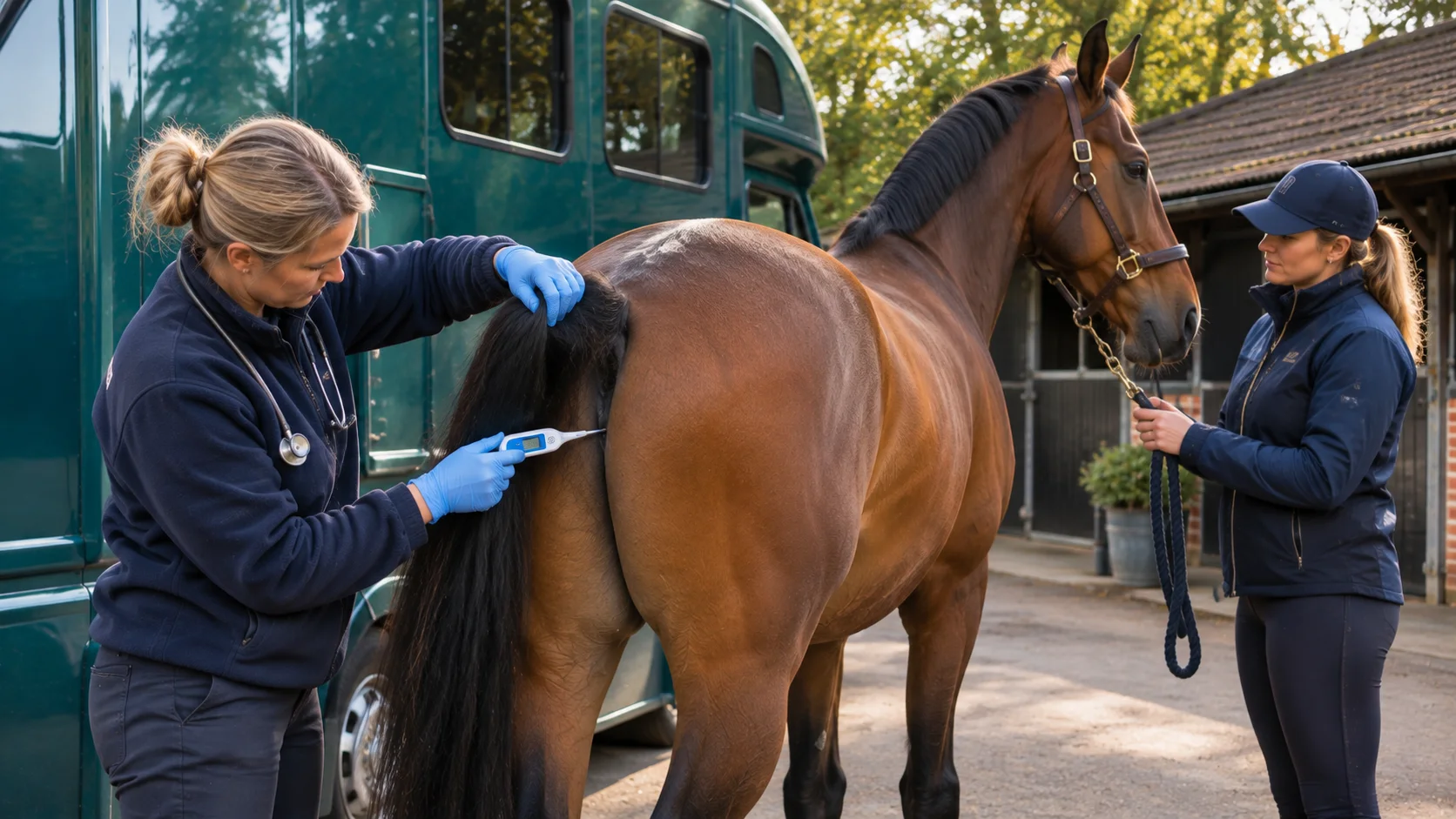

Travel sickness in horses does not mean the same thing as car sickness in people. In horses the term usually describes a serious respiratory infection, sometimes called shipping fever or pleuropneumonia, that can develop during or after a long journey. Alongside it sit milder problems such as travel stress, dehydration, weight loss and colic. Most horses travel well, but knowing the risks and early signs can make a real difference to the outcome.
This guide is general information for owners, not veterinary advice. If you are worried about a horse after a journey, call your vet.
Key points
- The risk of respiratory illness rises sharply with journey length, particularly beyond eight hours.
- Horses tied with their heads high for long periods cannot clear their airways properly.
- Take the horse’s temperature before and after long journeys and for a few days afterwards.
- Fever, dullness, cough, nasal discharge or reluctance to eat after travel needs a vet.
What is shipping fever?
Shipping fever is the common name for a bacterial infection of the lungs and the space around them (pleura) linked to transport. When a horse is tied with its head raised for hours, it cannot lower its head to drain mucus and dust from its airways. Combined with stress, dust from hay, exhaust fumes and dehydration, bacteria that normally live harmlessly in the upper airway can move into the lungs and multiply.
Research on horse transport has found that the chance of respiratory disease is many times higher on journeys of eight to 24 hours than on shorter trips, and higher again on very long journeys. That does not mean every long journey is dangerous, but it does mean long trips need planning.
Risk factors
- Journey length: the single biggest factor.
- Head position: tying horses too short and high prevents natural airway clearance.
- Dust: dry, dusty hay and bedding.
- Poor ventilation: closed windows, heat and humidity.
- Dehydration: horses that do not drink on the journey.
- Stress: unfamiliar companions, rough driving, a recent hard competition.
- Existing illness: horses with a cough, raised temperature or recent infection should not travel unless a vet advises.
How to reduce the risk
- Plan breaks. Stop roughly every four hours on longer trips to offer water and let the horse lower its head. Our guide to keeping horses hydrated explains how.
- Tie at a sensible length. Long enough for the horse to balance and lower its head a little, short enough to stop it turning round.
- Soak or dampen hay. This reduces dust significantly. Haylage is an alternative for some horses.
- Ventilate. Open vents and windows, and avoid parking with exhaust fumes blowing into the vehicle.
- Drive smoothly. Gentle driving reduces the physical effort of balancing.
- Break up very long journeys. An overnight stop with the horse off the vehicle can transform recovery. See long-distance horse travel.
- Only travel fit horses. A horse that is unwell before setting off is at much higher risk.
Take temperatures: the simplest early warning
Knowing your horse’s normal temperature at rest is valuable. For most adult horses it sits within a narrow band of roughly 37.5°C to 38.5°C, but individuals vary, so record it several times at home. Take the temperature before a long journey, on arrival, and morning and evening for two or three days afterwards. A rise above your horse’s normal range is often the first sign of trouble, appearing before coughing or obvious illness.
Signs to watch for after a journey
| Sign | What it may indicate | Action |
|---|---|---|
| Raised temperature | Infection, dehydration | Call your vet |
| Dull, depressed, off feed | Infection, colic, exhaustion | Monitor closely, call vet if not improving |
| Cough or nasal discharge | Respiratory infection | Call your vet |
| Fast or laboured breathing at rest | Pain, fever, lung problems | Call your vet promptly |
| Pawing, rolling, looking at flanks | Colic | Call your vet urgently |
| Reluctance to move, stiffness | Muscle problems, exhaustion | Rest, call vet if severe |
Travel stress and behaviour
Some horses show stress in transport by sweating, scrambling, kicking or calling. Stress raises heart rate and body temperature and makes illness more likely. Common causes include a previous bad experience, a partition that is too narrow, poor driving, and being separated from companions. Practising short calm trips, adjusting partitions, trying a different travelling position or vehicle, and driving very gently all help. Our guide to how to load a horse also covers building confidence.
Colic and travel
Changes in routine, reduced water intake and stress can contribute to colic around journeys. Keep feeding as normal as possible, give forage rather than large hard feeds before travel, and keep the horse drinking. Know the signs of colic and have your vet’s number and the number of a vet near your destination saved in your phone.
After the journey
- Let the horse settle, offer water and forage, and walk it in hand to loosen up.
- Check legs, coronet bands and tail for injuries.
- Delay hard work until the horse has recovered, especially after long trips.
- Continue temperature checks for a few days.
Frequently asked questions
Can horses get motion sickness?
Horses cannot vomit, so they do not show sickness in the same way people do. “Travel sickness” in horses usually refers to stress-related problems and respiratory infection.
How long after travelling can shipping fever appear?
Signs can appear during the journey or in the days afterwards. That is why temperature checks for a few days after a long trip are recommended.
Is it safe to travel a horse with a cough?
Ask your vet first. A horse with a respiratory problem is more vulnerable to complications in transport.
Summary
Most horses travel without problems, especially on short trips. On longer journeys, regular breaks, clean air, good hydration and sensible tying go a long way. Take temperatures before and after, and call your vet early if anything is not right. Official welfare guidance is available from GOV.UK.