

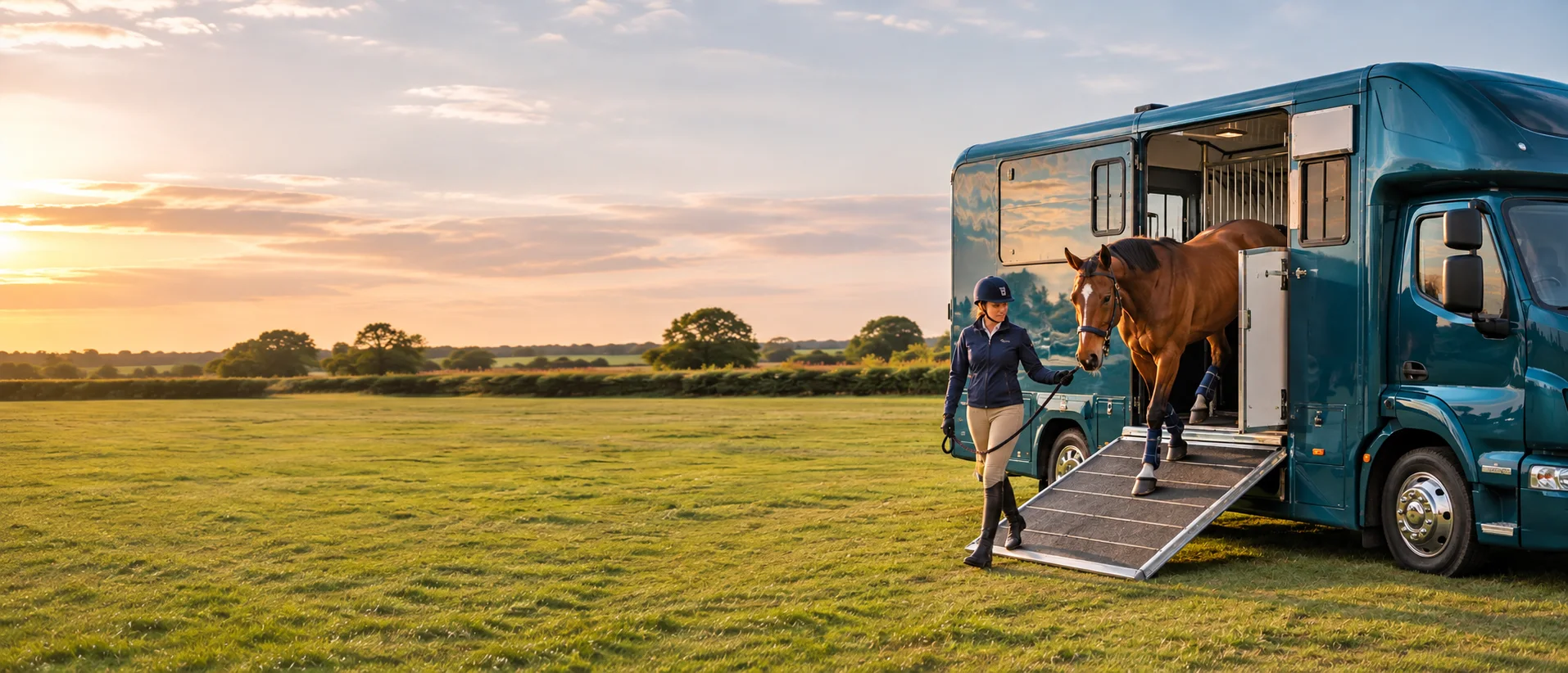

Long-distance horse travel asks more of horses than most owners realise. A three-hour drive to a championship, a move to a new yard across the country or a trip to the Scottish borders for a holiday ride all mean hours of balancing in a moving vehicle, often in warm, humid air with limited chances to drink. With good planning, though, most healthy horses cope well.
This guide covers planning the route, scheduling rest stops, overnight stays, what to monitor on the way and how to help your horse recover afterwards.
Key points
- Plan rest stops about every four hours, with water and forage.
- Keep single journeys as short as possible; UK welfare guidance suggests no more than 12 hours.
- On very long trips, an overnight stop with the horse off the vehicle aids recovery.
- Monitor temperature, drinking and droppings before, during and after.
Plan the route around the horse
- Choose smoother roads. Motorways and good dual carriageways usually give a steadier ride than twisting rural roads, even if the distance is longer.
- Avoid peak traffic. Stop-start queues are tiring for horses. Leaving Chelmsford early to clear the M25 or A12 before rush hour can make a real difference.
- Know your stopping places. Identify service areas with space for lorries and trailers, or lay-bys where you can park safely.
- Check vehicle restrictions. Low bridges, weight limits and narrow lanes near your destination.
- Driver hours. Plan breaks for the driver too, and share the driving if you can.
Scheduling rest stops
UK equine welfare guidance recommends short mid-journey rests roughly every four hours, with access to water and forage on the vehicle for around 45 minutes, and keeping single journeys under 12 hours. Experienced long-distance travellers often stop more often, especially in hot weather.
| At each stop | Why |
|---|---|
| Offer water | Horses rarely drink on the move |
| Refill haynets | Forage supports gut health and hydration |
| Check legs, boots and tail guard | Slipped kit causes rubs and trips |
| Check sweat and breathing | Early sign of heat stress or distress |
| Muck out wet bedding if possible | Reduces ammonia and slipping |
| Rest the engine and the driver | Fatigue affects driving smoothness |
Horses do not always need to come off the vehicle at short stops; standing still for a while is itself a rest. Unloading at unfamiliar service areas can be risky, so only do it where it is safe and the horse is reliable.
Overnight stops
For journeys that would run past eight to ten hours, an overnight stop lets horses lie down, eat and drink freely and recover before the next leg. Options include:
- Equine bed and breakfast venues. The British Horse Society’s Horses Welcome scheme lists approved overnight accommodation for horses and riders.
- Livery yards or equestrian centres that offer overnight stabling.
- Friends’ yards along the route.
Book in advance, check vaccination requirements, and bring your own feed, hay and water containers to keep changes to a minimum.
Preparing your horse
- Only travel horses that are fit and healthy. A horse with a cough or raised temperature should not set off without veterinary advice.
- Record normal temperature, pulse and respiration at rest in the days before.
- Give free access to water and forage for at least six hours before leaving.
- Dampen hay to reduce dust.
- Dress lightly; vehicles warm up quickly. See our guide to travel boots and rugs.
- Give the horse enough space and tie it so it can lower its head a little.
What to monitor
- Drinking and eating at each stop.
- Droppings and urine: fewer or drier droppings can signal dehydration.
- Sweating, especially patchy sweat or sweat under rugs.
- Behaviour: restlessness, pawing, dullness or reluctance to eat.
- Temperature: before, on arrival and for several days after. See travel sickness in horses for warning signs.
Driving for the horse
Smooth driving is the biggest single factor in how tired a horse is on arrival. Accelerate gently, brake early and progressively, take bends and roundabouts slowly and avoid sudden lane changes. Cameras in the horse area let the driver watch without stopping.
Recovery after arrival
- Unload, walk in hand and let the horse roll and settle.
- Offer water straight away and forage before hard feed.
- Rest for a day after very long journeys before serious work or competition.
- Keep monitoring temperature and appetite for two or three days.
Using a professional transporter
For very long or complex journeys, a professional transporter with suitable vehicles and experienced grooms can be the safest option. Commercial transporters on journeys over eight hours need a type 2 transporter authorisation, approved vehicles and contingency plans. Our guides to choosing a horse transporter and transporter authorisations explain what to check.
Frequently asked questions
How long can a horse travel without a break?
Plan to stop about every four hours to offer water and forage, and more often in hot weather.
Should I unload my horse at service stations?
Only if it is safe and the horse is reliable. Most short stops can be done with the horse on board.
Is it better to travel at night?
Cooler temperatures and quieter roads can help, but driver fatigue is a serious risk. Plan rest for the driver as carefully as for the horse.
Summary
Plan the route for smoothness, stop every few hours, consider an overnight break for very long trips and monitor your horse closely before, during and after. For official welfare requirements, see GOV.UK guidance on transporting animals in Great Britain.